


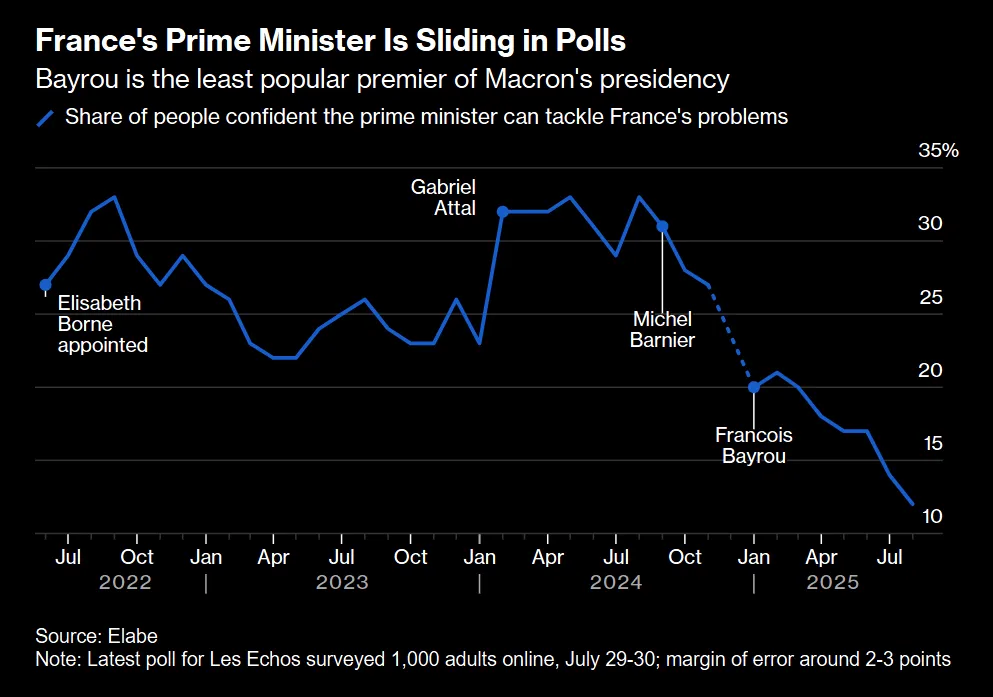
It is expected that the French government will collapse.
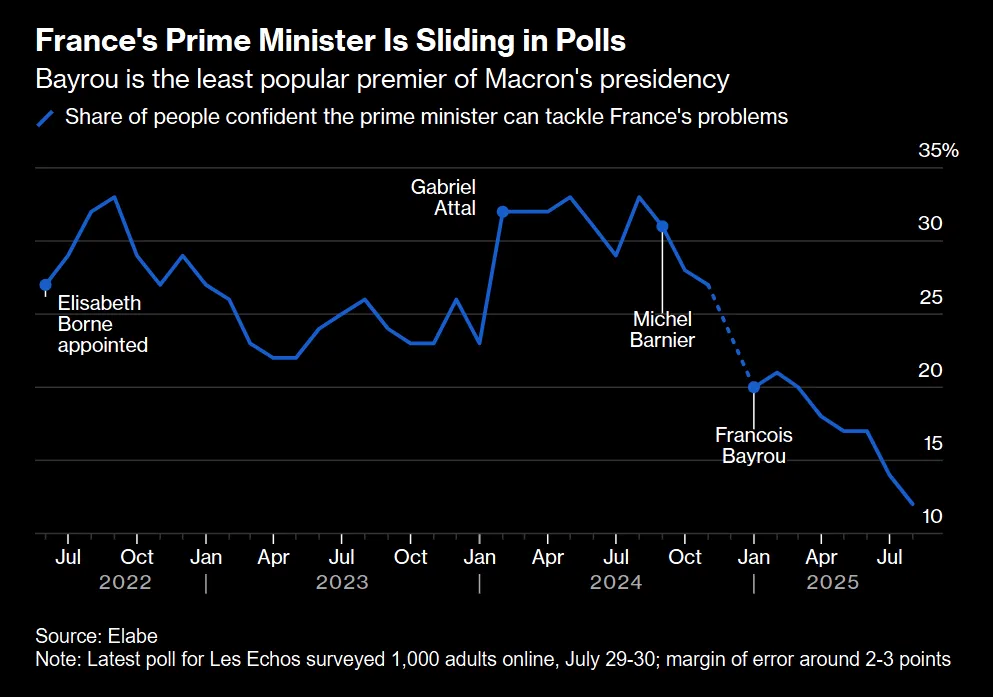
The Prime Minister Faces a New Vote of No Confidence Due to the Debt Crisis
Fears of a new political crisis gripped France on Tuesday as François Bayrou’s minority government appeared to be on the verge of being toppled in a vote of confidence next month.
The embattled French Prime Minister shocked the country on Monday by announcing that he had asked President Emmanuel Macron to convene an emergency parliamentary session on September 8.
Bayrou needs parliamentary support for his austerity measures aimed at reducing France’s growing national debt, but the main opposition parties—from the far right to the far left—have said they will not back the Prime Minister’s plan.
Far-right leader Marine Le Pen—whose National Rally party abstained in previous confidence votes against Bayrou, allowing him to survive—now says she wants the parliament to be dissolved and new legislative elections to be held.
Far-left firebrand Jean-Luc Mélenchon, who has already made unsuccessful attempts to bring down Bayrou, suggested that Macron should resign if 74-year-old Bayrou loses this time.
Macron, 47, has repeatedly faced calls to step down since he dissolved the parliament last year following far-right gains in the European elections, which plunged the country into crisis.
However, he has insisted he will remain in office until the end of his term and also stated he wants to avoid dissolving the parliament and calling early elections again.
If Bayrou is rejected by parliament, it would leave Macron searching for his seventh prime minister and cast a heavy shadow over the remaining two years of his presidency.
Bayrou aims to save around €44 billion ($51 billion) with measures that include reducing the number of public holidays and freezing spending increases.
Note that these “austerity” measures do not cut spending—they only freeze its growth.
Neither the Left nor the Right is satisfied with the so-called austerity.
Fears of a French Government Collapse Sharply Raise Its Borrowing Costs
The New York Times Reports: Fears of a French Government Collapse Sharply Raise Its Borrowing Costs
Fears that President Emmanuel Macron’s government could collapse for the second time in nine months amid a looming debt crisis shook financial markets on Tuesday. Investors dumped French stocks and pushed the country’s borrowing costs to some of the highest levels in the eurozone.
Fueling concerns, French Finance Minister Éric Lombard warned Tuesday morning that France might need assistance from the International Monetary Fund if the crisis isn’t contained. “I cannot assure you that the risk of IMF intervention doesn’t exist,” he said in a radio interview.
Later, however, he clarified in a social media post that France is “not under threat of intervention from the IMF, ECB, or any other international institution,” adding that the country is currently financing its debt “without difficulty.”
Trade unions opposing the proposed austerity measures met on Tuesday to discuss their next steps, as calls to “shut down France” on September 10 — by boycotting work, schools, and shops — gained traction on social media.
In a speech Tuesday before the C.F.D.T., France’s largest labor union, Prime Minister François Bayrou said lawmakers have “13 days to choose between chaos and responsibility.”
Finance Minister Lombard warned that without urgent action, the interest rate France will have to pay investors for government debt will surpass Italy’s — another financially strained EU country — within two weeks. If that happens, he said, “we’ll truly be at the bottom of the European Union rankings.”
What’s this about?
The crisis centers around the eurozone’s fiscal rules. The EU has never strictly enforced the Stability and Growth Pact or the Maastricht criteria — but now it wants to.
France is one of the biggest violators.
Compliance rules
- Deficit rule: A country is in compliance if (i) the general government budget balance is equal to or greater than -3% of GDP, or (ii) if this -3% threshold is exceeded, the deviation remains small (a maximum of 0.5% of GDP) and is limited to one year.
- Deficit rule: A country is in compliance if (i) the general government budget balance is equal to or greater than -3% of GDP, or (ii) if this -3% threshold is exceeded, the deviation remains small (a maximum of 0.5% of GDP) and is limited to one year.
France’s gross government debt is expected to reach approximately 116% of GDP in 2025.

Financial Crisis in Europe Centered on France
Please recall my publication from March 27, 2024: Expect a Financial Crisis in Europe Centered on France.
What is the main problem?
Eurointelligence says: “Technology is the main cause of the decline. Geopolitics is what accelerated it.”
Technology is not the problem. The Maastricht Treaty that created the Eurozone is flawed. And it cannot be fixed without unanimous agreement.
The EU is Dysfunctional
In one word, the EU is dysfunctional. That is the problem, not technology. The Maastricht Treaty itself is a large part of the reason for the EU’s dysfunction. The euro itself, with a single interest rate, is fundamentally flawed.
France is Unmanageable
On July 7, 2024, I noted: France is already unmanageable after the Pyrrhic victory of the Left-Green coalition.
I did not expect the National Rally to win a majority, but I also did not expect third place.
Success for Macron?
This was not a victory for Macron, who called early elections. Macron’s coalition, Ensemble, had 249 deputies in the National Assembly.
After this “success,” Ensemble will have 150–170 seats.
Macron will regret the elections.
Debt brakes and treaty requirements
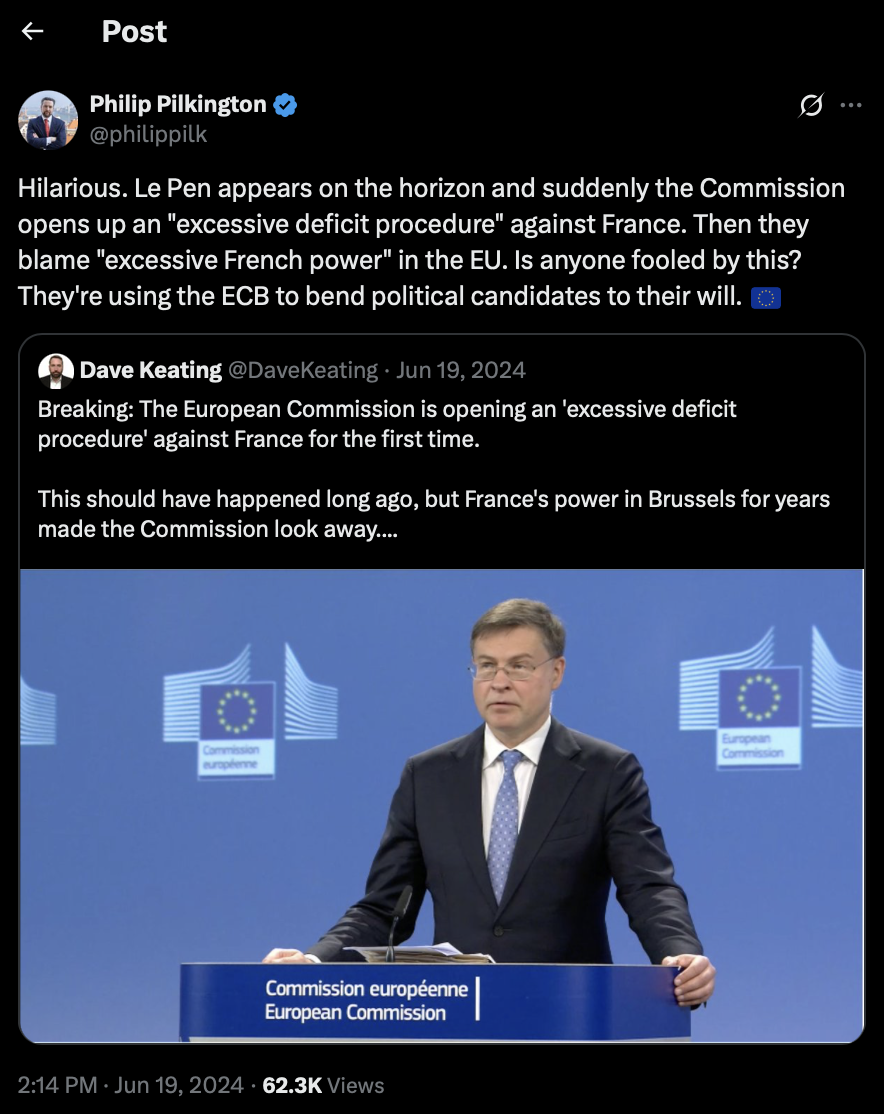
Philip Pilkington on Twitter:
“Funny. Le Pen appears on the horizon and suddenly the Commission launches an ‘excessive deficit’ procedure against France. Then they accuse ‘excessive French power’ in the EU. Is anyone buying this? They’re using the ECB to bend political candidates to their will.”
I discussed this tweet on June 21, 2024, in Debt brakes and treaty requirements that will hit the EU.
The EU has started an excessive debt procedure against France. This won’t stop here.
To reach a debt-to-GDP ratio of 60%, EU countries would need to cut spending or raise taxes by 2% of GDP on average every year for 46 years.
That also assumes no recessions or other emergencies during that time. And this is supposedly a “serious proposal.”
Let’s be clear — this won’t happen. But these clowns will probably try, if nothing else, to punish Le Pen.
Currency Crisis Ahead
Nothing is decided because nothing can be decided. Politically, it is impossible.
The French government is on the verge of collapsing again, as France is far from complying with debt limits and fiscal discipline rules.
If any party wins a majority in the next elections, it will regret having won. No one is ready or capable of dealing with these mandatory rules.
I keep repeating the idea: “a currency crisis is ahead.”
But since the global system is so confused, a crisis could start anywhere — the EU, the US, China, or Japan.
There is no financial sanity anywhere.
Varchev Absolute Trader
борсова платформа
- Търгувай над 3000 финансови инструмента: Crypto, Форекс, Акции, Индекси, Суровини, ETF-и
- Използвай платформа с директно изпращане ордерите на борсите
- Cloud base платформа - твоят трейдинг сетъп на всяко устройство
- Market Sentiment - търгувай с настроенията на инвестиционите банки
- Top movers - най-горещите трейдове във всеки един момент
- Stocks scanner - филтрирай най-подходящите за твоя трейдинг стил пазарни инструменти
- Heat map - Търгувай в посоката на големите играчи
Meta Trader 5
- Търгувай Crypto, Форекс, Акции, Индекси, Суровини - всичко на едно място
- Автоматизирана търговия с интелигентни стратегии и роботи (Expert Advisors)
- Разширен технически анализ с хиляди индикатора и инструменти
- Сигурност и стабилност – платформа, доверена от милиони по света
- Нулев марджин при насрещни/хеджирани позиции
- Без комисиона при търговия със CFDs
- Светкавично изпълнение на сделките
Read more:

Login to comment
Comments:
Leave a comment